
Overstock vs Customer Returns: Key Differences Explained
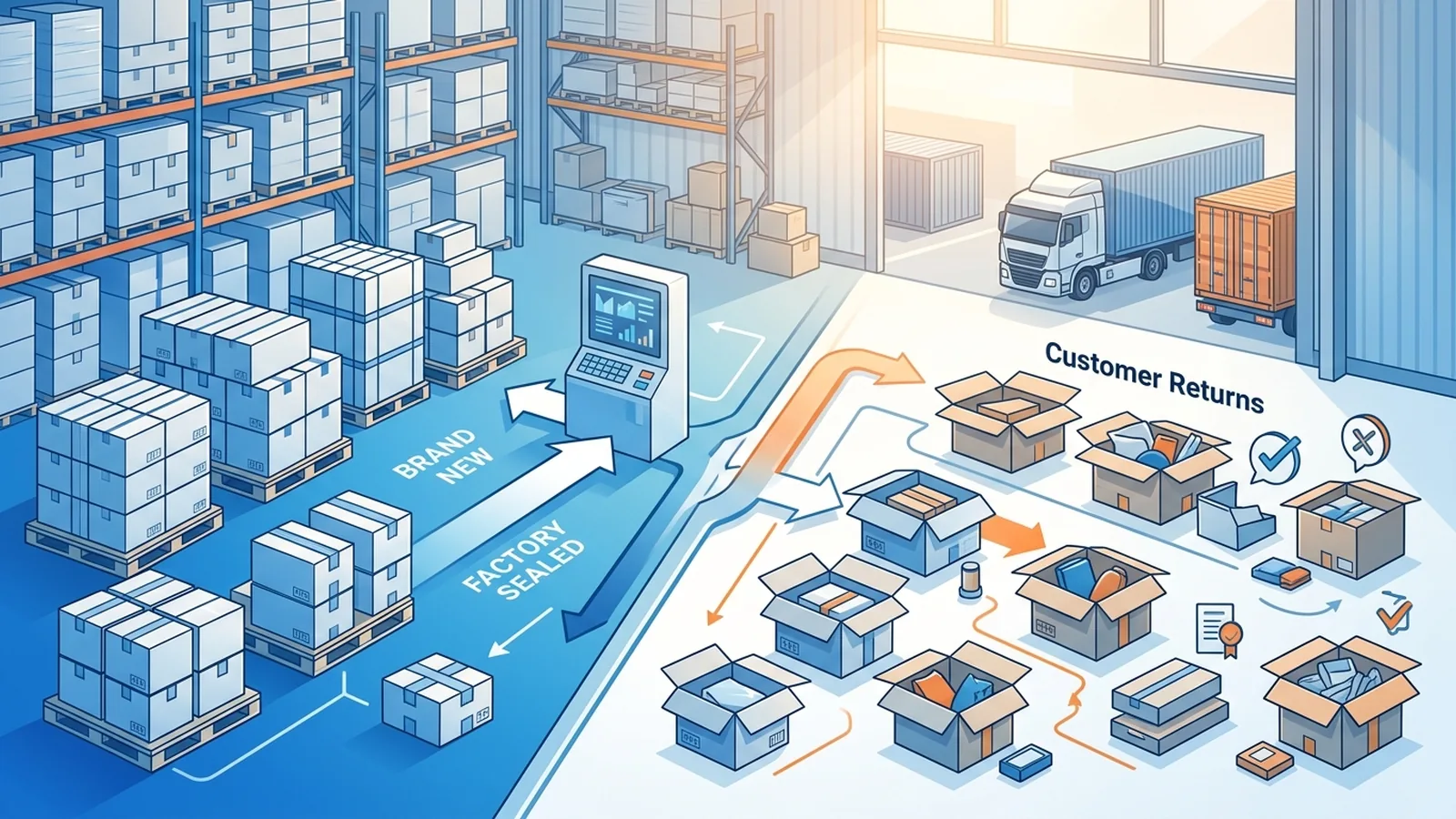
For Indian retailers, resellers, and small business owners navigating the B2B liquidation marketplace, understanding the fundamental differences between overstock inventory and customer returns can mean the difference between profitable ventures and costly mistakes. Both inventory types offer significant opportunities to acquire merchandise at wholesale prices well below retail, but they come with distinctly different risk profiles, quality expectations, and profit potentials.
The liquidation industry in India has grown substantially, with more businesses recognizing the value in purchasing surplus and returned goods. However, many newcomers to wholesale procurement make the critical error of treating all liquidation inventory as equal. Overstock and customer returns are fundamentally different products that require different evaluation criteria, pricing strategies, and business approaches.
This comprehensive guide will help you understand exactly what separates overstock from customer returns, how to evaluate each type for your specific business model, and which inventory category aligns best with your operational capabilities and profit goals. Whether you're sourcing electronics, apparel, home goods, or any other category through platforms like DealsGoKart's wholesale catalog, this knowledge will empower you to make informed purchasing decisions.
What is Overstock Inventory
Overstock inventory refers to brand-new, unused merchandise that retailers, manufacturers, or distributors have in excess of their sales forecasts or storage capacity. These products have never been sold to end consumers and typically remain in their original manufacturer packaging with all tags, labels, and accessories intact.
Overstock situations arise from several common scenarios in retail operations:
- Seasonal forecasting errors: Retailers order too much inventory for Diwali, summer, or wedding seasons and need to clear space for new stock
- Cancelled orders: Large wholesale orders get cancelled after production, leaving manufacturers with completed inventory
- Product line updates: When brands launch new models or versions, previous generation products become overstock even though they're perfectly functional
- Packaging changes: Rebranding or packaging redesigns can make existing inventory obsolete from a marketing perspective
- Store closures: When retail locations shut down, remaining inventory needs immediate liquidation
- Overproduction: Manufacturing runs exceed actual demand, creating surplus inventory
The key characteristic of overstock is its "new" status. These items have never been used, worn, or handled by consumers. They maintain full manufacturer warranty where applicable and can often be resold through regular retail channels without any disclosure requirements. For businesses exploring wholesale purchasing opportunities, overstock represents the lowest-risk category of liquidation inventory.
Common categories where overstock inventory appears include clothing and apparel, electronics and gadgets, home goods and furniture, toys and games, seasonal decorations, beauty and personal care products, and sporting goods. The predictable condition and quality make overstock particularly attractive for retailers who want to maintain consistent customer experiences.
What are Customer Returns
Customer returns, also called return merchandise or returned goods, are products that end consumers purchased and subsequently returned to the retailer within the return window. These items have left the retail environment, been in customer possession, and come back through the reverse logistics chain.
Customer returns occur for numerous reasons, not all of which indicate product defects:
- Wrong size or fit: Particularly common in apparel and footwear
- Buyer's remorse: Customer changed their mind after purchase
- Better price found: Customer found the same item cheaper elsewhere
- Gift returns: Unwanted gifts or duplicate items
- Functional defects: Product doesn't work as expected or arrives damaged
- Wrong item shipped: Customer received something different than ordered
- Aesthetic reasons: Product looks different than online photos
- Incomplete or missing parts: Accessories or components missing from package
The critical distinction is that customer returns have uncertain history and variable condition. While some returns are essentially new products in unopened packaging (often called "unopened returns"), others may be used, incomplete, or genuinely defective. This variability is why customer returns sell at significantly lower prices than overstock but also require more sophisticated inspection and grading processes.
Major e-commerce platforms and retail chains generate substantial volumes of customer returns, particularly categories with high return rates like electronics (15-20% return rate), fashion and apparel (20-30% return rate), and home goods (10-15% return rate). Processing these returns individually is cost-prohibitive for large retailers, so they bundle them into liquidation lots sold through B2B channels.
For buyers considering customer returns through liquidation lots, understanding the return reason, retailer grading system, and your own capability to inspect and refurbish is essential to profitability.
Key Differences Between Overstock and Customer Returns
While both inventory types fall under the liquidation umbrella, their differences extend far beyond simple definitions. Understanding these distinctions helps you evaluate opportunities, calculate true costs, and set appropriate expectations for your business operations.
| Factor | Overstock Inventory | Customer Returns |
|---|---|---|
| Condition | Brand new, unused, original packaging | Variable: new to used, opened to defective |
| Predictability | Highly consistent within each lot | Variable, requires individual inspection |
| Warranty Status | Full manufacturer warranty typically valid | Often no warranty or limited coverage |
| Resale Value | 60-80% of retail price achievable | 30-60% of retail price typical |
| Purchase Price | 30-50% of retail value | 10-30% of retail value |
| Inspection Needs | Minimal, mainly quantity verification | Extensive, item-by-item assessment |
| Processing Time | Fast to market, minimal prep needed | Slower, requires grading and possible repair |
| Legal Disclosure | Can be sold as "new" | Must disclose as "return," "open box," etc. |
| Risk Level | Low to moderate | Moderate to high |
| Skill Required | Basic wholesale knowledge | Product expertise, repair capability |
The operational differences between these inventory types significantly impact your business model. Overstock inventory suits businesses prioritizing speed-to-market, consistent quality, and lower operational complexity. Customer returns favor businesses with technical expertise, refurbishment capabilities, and tolerance for higher variation in exchange for potentially higher margins.
Geographic considerations also matter in the Indian market. Urban retailers with sophisticated customers may find customer returns harder to sell without significant discounting, while price-sensitive markets may readily accept well-graded returns at appropriate price points. Understanding your customer base is crucial when choosing between these inventory streams.
Quality and Condition Comparison
Quality assessment is where overstock and customer returns diverge most dramatically. Your ability to evaluate and grade inventory directly impacts profitability, customer satisfaction, and long-term business sustainability.
Overstock Quality Standards
Overstock inventory maintains manufacturer quality standards because items never entered the consumer market. When you purchase overstock through reputable B2B procurement channels, you can expect:
- Factory-sealed packaging: Original shrink wrap, tape, and seals intact
- Complete contents: All accessories, manuals, and components included as originally packaged
- Pristine condition: No signs of use, handling marks, or wear
- Valid date codes: Products within their shelf life (important for cosmetics, food items)
- Authentic merchandise: Genuine branded products with proper labeling
The primary quality concerns with overstock relate to age and obsolescence rather than condition. Electronics may be previous generation models, apparel might be last season's styles, or products could have older date codes. However, these factors affect resale price rather than fundamental product quality.
Customer Returns Quality Spectrum
Customer returns require a more sophisticated grading system because condition varies significantly. Professional liquidation buyers typically use a tiered classification:
Grade A Returns (30-40% of typical return lots):
- Unopened original packaging or opened but unused
- All contents present and intact
- No visible damage or defects
- Fully functional (for items requiring testing)
- Can often resell near overstock pricing
Grade B Returns (35-45% of typical return lots):
- Opened packaging with signs of minimal use
- All major components present, minor items possibly missing
- Minor cosmetic imperfections (small scratches, slight discoloration)
- Fully functional with no performance issues
- Suitable for "open box" or "refurbished" sales
Grade C Returns (15-25% of typical return lots):
- Obvious signs of use or wear
- May have missing non-essential accessories
- Cosmetic damage but structurally sound
- May require cleaning or minor repair
- Best for deep discount outlets or repair/refurbishment businesses
Grade D / Salvage (5-10% of typical return lots):
- Non-functional or major defects
- Significant damage or missing essential components
- Value primarily in parts harvesting or scrap
- Often unsellable in current condition
Understanding these grades helps you negotiate pricing, estimate refurbishment costs, and set realistic resale expectations. When evaluating customer return lots, always request detailed manifests with grading information and, when possible, inspection opportunities before purchase.
Pricing Considerations
Pricing strategies for overstock versus customer returns differ substantially because of their distinct risk profiles, processing requirements, and resale potential. Smart procurement requires understanding not just purchase price but total cost of acquisition.
Overstock Pricing Structure
Overstock inventory typically sells at 30-50% of retail value, though several factors influence exact pricing:
- Brand reputation: Established brands command premium pricing even in liquidation
- Age of inventory: Current season/generation products cost more than older stock
- Volume purchased: Larger lots often receive better per-unit pricing
- Product category: Electronics depreciate faster than non-tech items
- Market demand: Popular items retain higher liquidation values
Because overstock requires minimal processing, your purchase price closely represents your total acquisition cost. Additional expenses include shipping, basic inventory receiving, and storage—but no significant inspection or refurbishment costs. This predictability makes margin calculation straightforward and cash flow planning easier.
Customer Returns Pricing Structure
Customer returns sell at much lower entry prices—typically 10-30% of retail value—but come with hidden costs that impact profitability:
Purchase Price Components:
- Base lot price (10-30% of retail)
- Shipping and logistics (often higher due to less organized packaging)
- Inspection labor (10-20% of purchase price)
- Cleaning and refurbishment (5-15% depending on category)
- Repackaging costs (if required for resale)
- Additional storage time during processing
- Expected loss rate (10-15% typically unsellable)
These additional costs can double or triple your effective per-unit cost compared to the initial purchase price. Successful customer return buyers maintain detailed spreadsheets tracking all costs to ensure accurate margin calculations. Many newcomers underestimate processing costs and discover their "bargain" purchase yields minimal profit after accounting for true expenses.
Dynamic Pricing Factors
Several market conditions affect both inventory types but impact them differently:
- Seasonal timing: Post-season overstock drops in value; customer returns remain relatively stable
- Economic conditions: Recessions increase overstock volume, potentially lowering prices
- Retail trends: E-commerce growth increases customer return volume
- Platform competition: Multiple buyers on B2B marketplaces can drive prices higher
Profit Margins and ROI Potential
Understanding realistic profit expectations helps you choose the right inventory type for your business model and financial goals. Both overstock and customer returns can be profitable, but through different mechanisms and with different risk-reward ratios.
Overstock Profit Potential
Overstock inventory offers predictable, moderate margins with lower risk:
Typical Financial Profile:
- Purchase cost: 30-50% of retail value
- Resale price: 60-80% of retail value
- Gross margin: 30-50% on cost
- Processing costs: 5-10% of purchase price
- Net margin: 25-40% on cost
- Time to market: 1-2 weeks
- Annual ROI potential: 150-300%
The advantage of overstock is volume velocity. Because items require minimal processing and can be sold through regular retail channels, inventory turns quickly. A retailer might cycle through overstock inventory 6-12 times per year, generating strong annual returns despite moderate per-transaction margins.
Overstock also allows for predictable scaling. As you prove the model with initial purchases, you can confidently increase order sizes knowing quality and margins remain consistent. This predictability makes overstock suitable for businesses seeking steady growth without operational complexity.
Customer Returns Profit Potential
Customer returns offer higher potential margins but with greater variability and risk:
Typical Financial Profile:
- Purchase cost: 10-30% of retail value
- Processing costs: 15-25% of purchase price
- True cost basis: 12-37% of retail value
- Resale price: 40-70% of retail value (varies by grade)
- Gross margin: 40-70% on true cost
- Loss allowance: 10-15% unsellable rate
- Net margin: 30-55% on true cost
- Time to market: 3-6 weeks
- Annual ROI potential: 100-250%
The customer returns model generates higher margins per unit but slower inventory velocity due to processing requirements. Annual ROI can be strong but requires more hands-on management, technical expertise, and operational infrastructure.
Successful customer return businesses often develop specialized expertise in specific categories—electronics refurbishment, apparel grading, appliance repair—that allows them to extract maximum value. This specialization becomes a competitive moat that justifies the operational complexity.
Hybrid Approach
Many experienced liquidation buyers use a portfolio approach, balancing overstock and customer returns to optimize both cash flow and profitability. A typical hybrid model might allocate 60-70% of capital to overstock for predictable cash flow and 30-40% to customer returns for margin enhancement. This balanced approach manages risk while capturing opportunities across both inventory categories.
Which is Better for Your Business?
The question of whether overstock or customer returns is "better" has no universal answer—it depends entirely on your business capabilities, market position, and strategic goals. Here's a framework to help you decide which inventory type aligns with your situation.
Choose Overstock If You:
- Value predictability: You need consistent quality for maintaining customer satisfaction and repeat business
- Have limited inspection capacity: Small teams without technical expertise or time for detailed grading
- Want faster cash cycles: You prioritize quick inventory turns over maximum margins
- Operate in quality-sensitive markets: Your customers expect new, perfect condition merchandise
- Lack refurbishment capabilities: No space, tools, or skills for repair and reconditioning
- Are building your business: New to liquidation and learning the market
- Need scalable operations: Want to grow without proportionally increasing operational complexity
- Prefer omnichannel sales: Plan to sell through multiple platforms and retail locations
Choose Customer Returns If You:
- Have technical expertise: You understand product functionality and can diagnose issues in your category
- Can process inventory: You have space, tools, and labor for inspection and refurbishment
- Target price-sensitive markets: Your customers prioritize value over "new" status
- Want higher margins: You're willing to work harder per unit for better profitability
- Have repair capabilities: You can fix minor defects and restore functionality
- Understand disclosure requirements: You can properly grade and accurately represent product condition
- Have category specialization: You focus on specific product types you know deeply
- Can absorb inventory losses: You have capital cushion for the 10-15% of items that prove unsellable
Market-Specific Considerations for India
Indian market dynamics add unique factors to this decision:
Tier 1 cities (Mumbai, Delhi, Bangalore): More sophisticated consumers often prefer overstock for quality assurance, though well-graded customer returns can succeed with proper disclosure and pricing.
Tier 2 and Tier 3 cities: Price sensitivity often outweighs "new" status, making customer returns viable when properly graded and priced. Local repair ecosystems can support refurbishment operations.
Online vs. offline sales: E-commerce platforms require detailed product descriptions and condition disclosure, making overstock simpler to list. Physical retail allows customers to inspect customer returns directly, potentially increasing acceptance.
Category preferences: Indian consumers show varying openness to returns by category—electronics see more acceptance than personal care items or undergarments.
Tips for Sourcing Both Inventory Types
Successful liquidation purchasing requires strategic sourcing practices that protect your investment while maximizing opportunity. These practical tips apply whether you're buying overstock, customer returns, or both.
Due Diligence Before Purchase
- Request detailed manifests: Get item-level lists with quantities, retail values, and condition grades before committing
- Verify seller reputation: Use established platforms like DealsGoKart that vet sellers and provide buyer protection
- Ask about return policies: Understand what recourse you have if inventory significantly differs from description
- Calculate total landed cost: Include shipping, taxes, inspection time, and processing in your evaluation
- Research retail values: Verify claimed retail prices against current market rates, not inflated MSRPs
- Inspect samples when possible: For large purchases, request sample inspection before committing to full lots
Negotiation Strategies
Whether dealing with overstock or customer returns, effective negotiation can significantly improve your margins:
- Buy in volume: Larger purchases typically unlock better per-unit pricing and shipping rates
- Be ready to move fast: Cash-ready buyers who can close quickly often receive preferential pricing
- Build seller relationships: Repeat buyers get first access to better inventory and preferential terms
- Point out risk factors: Older date codes, seasonal items, or condition concerns justify lower pricing
- Request mixed lots: Combine fast-moving overstock with higher-margin returns to balance your portfolio
Quality Control Processes
Implement systematic quality control regardless of inventory type:
For Overstock:
- Verify quantities match manifest
- Check packaging integrity and seals
- Confirm product authenticity and proper labeling
- Document any discrepancies with photos immediately
- Test sample units for electronics to ensure functionality
For Customer Returns:
- Develop standardized grading criteria for your categories
- Perform item-by-item inspection and assign grades
- Test functionality on all applicable items
- Document condition with photos for your records and resale listings
- Separate items into resellable, refurbishable, and salvage categories
- Track your grading accuracy against actual sales performance
Building Supplier Relationships
Long-term success in liquidation purchasing comes from developing strong supplier networks:
- Pay promptly: Reliable payment builds trust and access to better inventory
- Provide feedback: Help suppliers improve their grading and descriptions
- Be reasonable with disputes: Address genuine issues professionally without frivolous complaints
- Communicate your needs: Let suppliers know what categories and volumes you're seeking
- Consider exclusivity: Some suppliers offer better pricing for buyers who commit to regular purchase volumes
Scaling Your Operations
As you grow comfortable with liquidation purchasing, consider these scaling strategies:
- Start with one category you understand deeply before diversifying
- Develop category expertise that allows you to evaluate deals quickly and accurately
- Create standard operating procedures for inspection, grading, and pricing
- Invest in proper tools and workspace as volume increases
- Build a team with specialized skills (grading, repair, listing, shipping)
- Use data to track performance by supplier, category, and inventory type
- Explore direct relationships with major retailers for consistent supply
Conclusion
The choice between overstock inventory and customer returns isn't about finding a universally "better" option—it's about understanding which inventory type aligns with your business capabilities, market position, and profit objectives. Overstock offers predictability, consistent quality, and straightforward operations that suit businesses prioritizing volume and velocity. Customer returns provide higher margin potential but demand technical expertise, processing capabilities, and tolerance for variability.
Many successful liquidation businesses ultimately incorporate both inventory types, using overstock for reliable cash flow and customer returns for margin enhancement. This hybrid approach allows you to capture opportunities across the full spectrum of liquidation inventory while managing risk through portfolio diversification.
The Indian B2B liquidation market continues to mature, with growing inventory availability and increasingly sophisticated platforms connecting buyers and sellers. Whether you're a retailer looking to improve margins, a reseller building your business, or a distributor exploring new supply channels, understanding these inventory fundamentals positions you for success in the wholesale liquidation marketplace.
Remember that successful liquidation purchasing is built on knowledge, relationships, and systematic processes. Start with smaller purchases to learn your market and refine your evaluation criteria. Track your results carefully to understand which inventory types, categories, and suppliers deliver the best returns for your specific business model.
Ready to start sourcing quality overstock and customer returns inventory for your business? DealsGoKart connects Indian retailers and resellers with verified wholesale liquidation suppliers across categories. Browse thousands of lots, compare pricing, and access detailed manifests with transparent condition grading. Whether you're seeking pristine overstock for fast-moving inventory or high-margin customer returns for refurbishment, you'll find trusted suppliers and competitive pricing on India's leading B2B liquidation marketplace. Create your free buyer account today and discover wholesale opportunities that match your business needs and capabilities.
Frequently asked questions
Overstock inventory consists of brand-new, unsold products that retailers ordered in excess, while customer returns are previously purchased items sent back by customers for various reasons. Overstock items are typically in perfect condition with original packaging, whereas customer returns may have varying conditions from opened boxes to minor defects.
Ready to source smarter?
Ready to source high-quality overstock and customer returns inventory? Explore thousands of verified wholesale lots on DealsGoKart today and find the perfect inventory for your business needs.